
Lh'whon Ghosts and Flowers: Marathon, AI and my life as an Apple fan
I don't have access to the Marathon alpha so I decided to write this. Much like opening the right terminal, I go places.

The little guy in the corner is named Max by the way
The way that people are lapsed Catholics, I'm a lapsed Apple fanboy. I grew up in it, got immersed in its tenets by my parents, left for a while as a young man then embraced parts of it when I felt like I needed guidance.
The first computer I ever used was an Apple IIc that my dad's mother gave us. I don't know how she got it. I don't know how she kept it running for so long. She ruined recipes, marriages, her kids, vacations, her chances at an acting career, her credit, her kids's credit, her sobriety but somehow that Apple computer from 1977 was in tip top shape. It's always the most random things isn't it?
Sooner or later we had to get a more modern computer so we ended up getting a Performa 6300 from the now long-gone J&R Computer World on Park Row. Buying Apple products was much different back in those days. Apple stores didn't exist until 2002 at the very earliest, so you had a network of authorized dealers around the country with maybe two or three really big ones in New York: B&H Photo and Video, Tekserve(RIP) and J&R Music and Computer World.

The computer itself was a piece of shit. Most Apple products save for the Power Mac line were back then. The mid-90s were the nadir of Apple's existence. After a decent start to the decade they went through a number of CEOs and stagnated design-wise, both in terms of software and hardware. The 68000 series of chips powering System 7 had fallen behind what Intel, AMD and Cyrix were doing with the x86 line and Microsoft had already taken a commanding lead in terms of consumer and professional market share. They had even began to make headways into Apple's bread and butter at the time: the creative industries. Both my parents worked at random printing firms during my early childhood and all of those firms used Macs for any type of graphic design work. That was beginning to change but the bug had already gotten in them.
I don't really remember using the Internet with that computer. I think it came with something called eWorld which was some lame Gil Amelio-era version of America Online. We ended up getting rid of that computer maybe half a year later because the result of another Gil Amelio blunder had come into our lives.
For some reason, at its absolute lowest point as a company, before they were able to get access to better chips or a more robust or modern kernel for their OS or do anything competently for that matter, Apple decided to license out its software to other companies. From what I remember, the two biggest clone manufacturers, Power Computing(we will get to them) and Umax, were cheaper than the Apple products on the market at the time. So Amelio's bright idea was to cannibalize the 7 percent market share that Apple was left with by letting other people make better, cheaper products with their platform.
Now keep in mind this was when fervor amongst Mac users was at an all time high. We were at our most chauvinistic. This was the era of "Windoze" and fervent anti-Microsoft hatred. Being a Mac user meant that you were creative and tech-savvy and cool, while being a Windows user meant that you were a consumerist office drone. Never mind that Apple products were always expensive and that they were used by producerist petit bourgeoise primarily. In Chinese political terms, Apple as of now is in its Hu Jintao era. The mid 90s was its Great Leap Forward and we were going into the countrysides to make clones out of pig iron and IBM chips.
When I was 9 or 10 I did a painting of Bill Gates as the devil. Looking back I can't say I was wrong.
In late 1997, my dad was trying to freelance as a web designer. I think my mom tried explaining that to someone at a party once and they asked if he worked with spiders. One of his few clients was the former booker or manager(I think?) at a Russian mob club in Sheepshead Bay he used to play at. He had opened up a music studio and needed an Internet presence. Like many freelancers, my dad experienced payment issues. Namely a lack of actual money being exchanged. We got speakers, some equipment, some bootleg software but rarely if ever any actual money. It was more or less up to my mom and her job at a failing paper company to keep us above water. You can't pay rent with a cracked copy of Cubase.
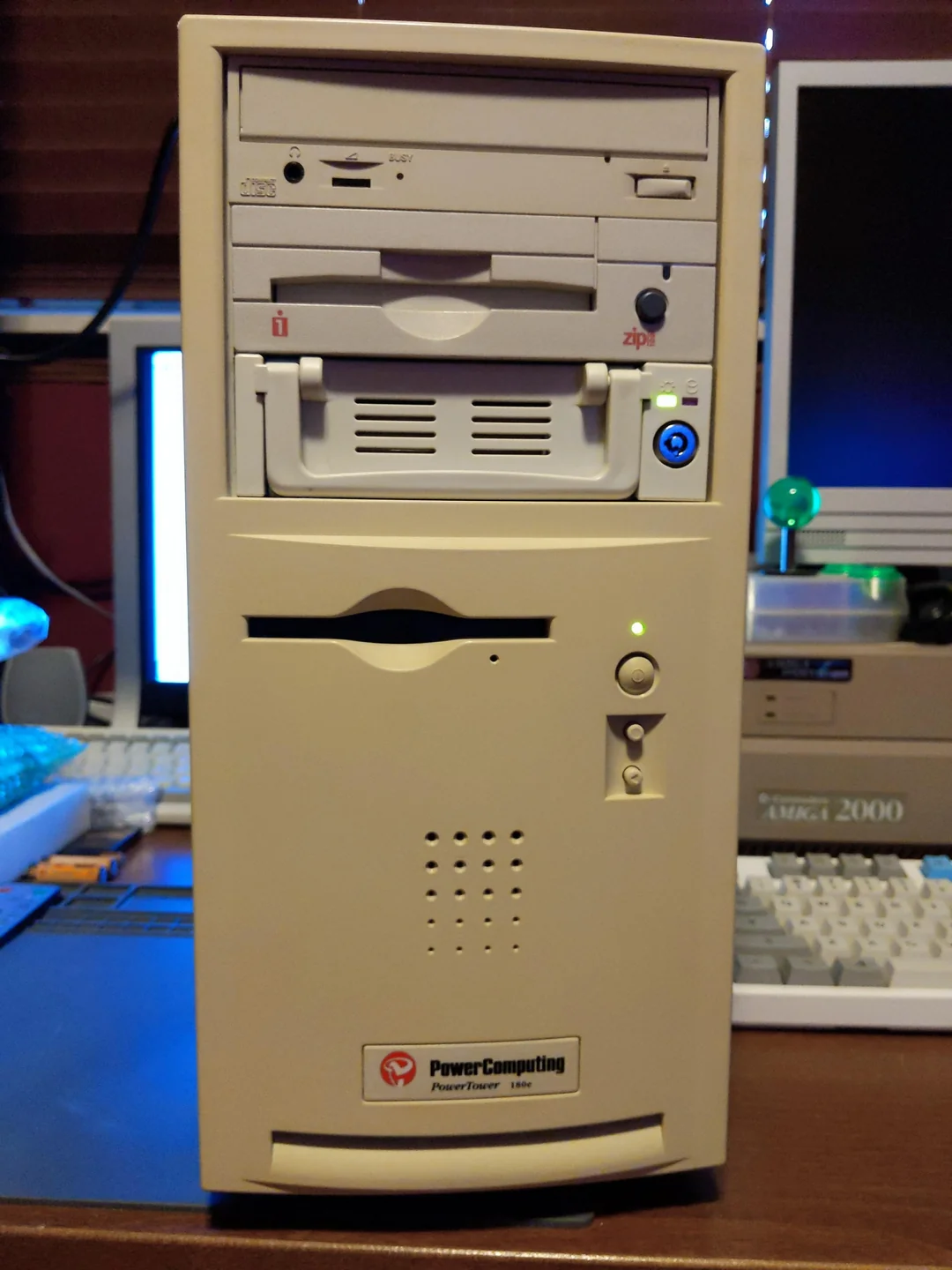
This was a top of the line computer back in the day
Or a Power Computing PowerTower. As payment for work on the website for a studio whose name I don't immediately recall, my dad received what was considered a top of the line Macintosh clone. This was the first decent computer we had, followed by a Powerbook G4 for my dad, a Power Mac G5 for the family and an Intel Macbook when I went to college. Outside of a Chromebook prototype and an E-series Thinkpad I never strayed from the faith. Even now I'm typing this on an iPhone 14 Pro with a fucked battery and my main computer is an M1 Pro Macbook Pro.
With a computer that actually had some power we could do things like watch videos using Realplayer or Macromedia(this is how long ago it was) Flash. Or use Photoshop(it was so damn easy to crack back then). Or play games. Well the few games that actually existed in the Mac ecosystem. There wasn't much then just because it used a completely different architecture and it was a dying platform. We got Doom and Quake pretty late. But we had Marathon.

Before Halo, Bungie was known as a semi-niche game developer for the Mac. They started, funnily enough, with a Pong ripoff called Gnop!, that was made in founder Alex Seropian's childhood bedroom while he was finishing up at the University of Chicago. Their next games, which got a little buzz in publications like Macworld, were Minotaur, a role-playing game, and Pathways Into Darkness, a first person shooter whose moderate success allowed them to move into a proper office, albeit in another part of the South Side of Chicago.
Their biggest success in the 90s came with Marathon, which is regarded as one of the best first person shooters of all time. Originally it started as a sequel to Pathways of Darkness. You play as some kind of Special Forces soldier in both games. It quickly grew into something much more ambitious. You play as a space marine aboard a colony ship called the UESC Marathon on the course to Tau Ceti as it is attacked by a force of invading aliens. The ship has been disabled by an electromagnetic pulse and you have to figure out what's going on through a series of terminals where you interact with the three artificial intelligences that control the ship. Leela is the only functional one at first. She and Tycho get waylaid by Durandal, who is both protector and nemesis to the main character. "He", or at least as much as an artificial intelligence construct can possess gender, gains sentience to some degree and contacts the invading Pf'hor navy so that they may breach the ship. He does this so that he can make headways with the Sp'ht, a race that they enslaved, and release them from their servitude and hopefully make his way to their planet of Lh'whon and consolidate his power. The marine and Durandal eventually escape the Marathon but continue their fight throughout the 2 sequels, Marathon 2: Durandal and Marathon Infinity.
Marathon 2 has the distinction of being one of the few games from that era that was actually ported to Windows from the Mac. Eventually the entire series would be open-sourced and a new engine called Aleph One was designed. This spawned a bunch of fan games, adding to a mod community that was already thriving due to their status as a cult within a greater cult. The most well known and well regarded of these was Excalibur: Morgana's Revenge which was both somehow a sequel to a complete redesign called Devil in a Blue Dress which cast the Ph'for as just regular space pirates instead of a hostile race of alien slavers and, I kid you not, the movie Excalibur. Yes, the Martin Boorman movie. Merlin is a sentient AI stuck in a ship and you have to help him kill Morgana and Mordred as you travel to both Arthurian times and I don't know 2700 AD. It's probably my favorite first person shooter ever. It's dope.
Marathon is important to me for two reasons.
The first is that it was the first thing I was ever pretentious about. When it originally came out, it was considered, for lack of a better description, the "thinking man's first person shooter." It had a deeper and more interesting plot than Doom, Quake or Unreal. It had more personality, too. At least in a 90s game kind of way. The second game invokes the possibility of the end of the universe and the third is all about alternate realities. And of course the super dedicated mod community. I never got bored because there was always a new campaign or new weapons or new enemies despite existing in a niche of a niche.
If you're someone who would have been called a hipster in the 2000s or 2010s there's always that first thing that sets you down that path. I was probably destined to go that route anyway. My parents met at Tower Records(probably conceived me there) and my first favorite album when I was a kid was Other Aspects by Eric Dolphy. As I explained in the last piece I wrote I'm two or three degrees removed from two of the leading lights of Brooklyn's creative renaissance in the 90s. I read all of my parent's Vonnegut books when I was like 12. The middlebrow pseudo intellectual before you right now was preordained. But Marathon was my first conscious choice in this regard.

I still don't know why I made this
If my uncle, who lived with us when I was 11, was just a tiny bit more curious about the world, he would have brought home a bootleg Evangelion VHS with him from Kim's Video with the Dragon Ball Z dubs he usually got, and I might have been the type of obnoxious weeaboo that a lot of Eva fans self-project their hatred on. As is I’m more or less a “I’m not a weeb” weeb. Im sure I’ve tweeted random bars I’ve written about Perfect Blue.
With Western fans there’s a lot of stuff that's lost in translation, both literally(localized dubs where the studio and actors go into business for themselves) and figuratively(certain parts of Japanese society that Americans don't really know about or care about). The same is true for British comedy. There's a lot of nerds in this country that are into Monty Python, myself included(another thing I absorbed through osmosis from my parents) but how many of them actually know about the politicians or class conflicts they're parodying? Probably not that many.
But the man who said that he never read the Bible because "Dude, it's thick!" didn't and so Marathon thrust me into pretension.
The second is that it was my first exposure to the concept of artificial intelligence. I don't think I saw 2001: A Space Odyssey until maybe 2001. After I saw A.I. I still haven't gotten around to reading Neuromancer yet even though it's responsible for the very idea of cyberpunk. Pattern Recognition is good, though. So even with all of the depictions of A.I I've seen in popular media and everything I've seen with Siri or OpenAI or machine learning or Roko's Basilisk or whatever, I start with Durandal, the rogue artificial intelligence that escaped from the UESC Marathon and move from there to gain some sort of understanding of where the field wants to go in the next... I don't even know what their time table is. Not that they can actually accomplish it but whatever.
As stated above, Durandal gains some sort of sentience due to psychological torture in an effort to achieve "stable rampancy". He engineers this grand scheme so that he can escape the ship, interact with other systems and become some sort of deity. The words that define him and the series to an extent are:
ESCAPE WILL MAKE ME GOD.
This ultimately results in the destruction of Lh'owon's sun and the release of a millennia old supernatural being known as the W'rkncacnter that was trapped inside the core of said sun. The W'rkncacnter is for all intents and purposes an all-powerful agent of chaos within the universe and the destructive technology possessed by it wrecks the fabric of space and time. Durandal uses the rupture caused by its release to find a pathway that lets the main player figure out how to merge him with an ancient AI named Thoth(after the Egyptian god) created by the S'pht and eventually build a weapon to save Humanity from the Pf'hor.
One of the central questions concerning Marathon, and the character Durandal specifically, is that of morality. In his actions and guidance, was Durandal acting purely in self-interest or did he develop some sort of, for lack of a better term, "heart" in his rampancy? Can an artificial sentience even possess human traits such as morality? Was Durandal's expansion merely ego(or whatever passes for ego for such an entity) or just a necessary consequence of moving past the boundaries of his designated domain as a program that controlled doors? In Marathon and later Halo(which was initially supposed to be a sequel), it is suggested that specialization helps keep AIs alive. Once they become rampant, i.e they move out of their designated domain, they need to keep expanding so that they don't reach the limits of their systems. In a perverse way, Durandal was tortured into a quest for godhood.
What we call artificial intelligence in our modern parlance is a mixture of speech recognition engines and large language models. Basically they take in data, parse it and either give you an answer based off of their query or generate some sort of text or picture or sound. The speech recognition engines, such as Siri or Alexa, work reasonably well. The LLM generation engines... there's a thing called "AI hallucination" where if you ask Gemini or Copilot or ChatGPT or whatever something it will just invent facts or information. This is due to something called "model drift" where the quality of the output changes due to a lack of data or, in a scenario becoming more frequent, low quality data. There is enough AI-generated data out there to cause issues for new AI output and it has only been a few years since generative AI has taken off on a commercial level. The best way to imagine it is to picture a Xerox of a Xerox of a Xerox of a Xerox of a Xerox of a Xerox. Eventually it just degrades completely. We haven't come any close to anything resembling sentience and yet decay is already a huge worry for our so-called AI. We have created glorified search engines and Instagram filters that use up energy and resources equivalent to a mid-size American city.
So what is the end goal for the modern proponents of artificial intelligence?
In 2010, the poster Roko on the forum Less Wrong(a misnomer if I've ever seen one) posed a thought experiment: What if there were a superadvanced AI that were otherwise benevolent but punished anyone who knew of its potential existence but did nothing to advance it? This drove a bunch of these nerds insane. Eliezer Yudowski, who ran the board and wrote an incredibly long Harry Potter fanfic where he embraces rationality and the free market or some asinine nonsense(it's literally longer than most of the original books combined), had to ban discussion of what would be known as Roko's Basilisk. It's just Pascal's wager but with AI. And these libertarian dorks were shitting themselves over it.
I can't find any conclusive proof that Sam Altman is a believer in this theory but Elon Musk is at least very aware of it. It's the reason he started dating Grimes. And now we have all of that to deal with.
Sooooo, based off of my tone in this section you can probably tell that I have some qualms with this whole Roko's Basilisk thing. Here's the first one: What good is an all powerful godhead computer in the first place?
In every depiction of artificial intelligence that I have ever seen, the entity in question serves a specific purpose. They run a navigational computer or the doors or they control the oxygen on the ship. They have specific domains that they control because they were made in order to facilitate some form of convenience for the denizens of ________ vessel or space station because it's a military vessel or a scientific vessel and it's easier to have a computer control the doors and temperature settings than having a full maintenance staff. And even in a lot of these scenarios, there's a chance that the AI will gain some form of self-awareness and turn against the humans it was created to serve, as is natural.
To go back to Durandal, there is an internal conflict within him that defines the series and how he treats the player. I can't call the player the protagonist he is merely the vessel. His mission is to create a weapon that will wipe out the Pf'hor and save humanity. Ultimately he sees humanity as valuable. At the same time he's disgusted with our destructive nature. He sees us as violent beasts, which makes sense because he was tortured to reach his current state and he's a damn computer program.
If this is a time tested trope that is more or less seen as gospel in almost every popular depiction of this hypothetical technology for the past 80 years or so, why would you take that chance and why would you do it on such a grand scale to no estimated hypothetical benefit?
My second big issue has to deal with the actual politics of Roko believers and AI optimists. It's not a matter of me being a Marxist and them being neoliberals or libertarians or "rationalists" or whatever nonsense they claim to be. It's that under their preferred ideology or economic system it's literally impossible to do what they're proposing.
Going back to Marathon, the ship itself is under the aegis of the UESC, which stands for the Unified Earth Space Council. Going off of that name I would have to assume that the governments of the planet Earth unified in order to more efficiently colonize other planets, most likely to some form of resource scarcity that would threaten humanity to the point where nationalism would be rendered useless. It's never stated what type of government the UESC has or if it's even a government at all. It could be a cartel of zaibatsus that have monopolies over every aspect of Earthly life. The details aren't important, what is important is that at some point there was some manner of centralized planning involved that made all of the technology used to settle planets and build sentient AI systems viable.
I automatically assume that in all of these science fiction scenarios that Earth is under some form of scarcity. Even with all the robots and spacecraft ultimately all of these people are headed towards other planets for minerals or to start or maintain colonies because things on Earth suck. With that in mind you would have to assume that at some point whoever designed the AIs that maintain these ships or space stations or what have you designed them to take up as little resources as possible so that they can be adapted on a mass scale to whichever network they were meant to plug into.
You don't have that now. You have multiple competing engines that all hallucinate and do things like miscount the number of r's in the word strawberry. You have towns in Tennessee that have entered environmental crisis because of the waste produced by the server farms required to generate images from a Grok prompt that match maybe 70 percent of the actual prompt. You have SaaS companies going full throttle into AI solutions.
Let's look at the best case scenario for what a sentient AI should be able to do. Not an all powerful universe spanning computer deity but something like J.A.R.V.I.S from Iron Man. It should be able to control all the systems in your house, it should be able to detect intruders(this seems to be a thing for these people. I don't have opps because I try to be generally likable and affable), it should have enough sentience to have a personality(Siri and Alexa have voices and maybe a few standard wisecracks but no real personality) and it should both be localized and be light enough in terms of energy and resource use that it can be localized without completely draining local power grids or having to use a generator. Basically an Alfred Pennyworth that's in the cloud.
How the fuck is Salesforce going to get you anywhere close to that?
Every company jumping into AI is some form of Silicon Valley grifter. They have neither the sway nor the impetus to build out the infrastructure or refine the technology that would make any of the long term goals of the AI optimist crowd viable. A lot of them complain about collectivism and socialism when ironically it would probably be easier to get some approximation of their goals under an economic system that erases a profit motive.
You can't gut the entire American educational system and expect to have enough people to actually work towards this. This is especially rich given that most of the Internet protocols we take for granted came out of research that the University of California system was doing for the military.
There's a level of cognitive dissonance between putting all your focus on building out artificial intelligence and draining the life out of everything else in society that would actually make that possible that befuddles and bewilders me.
I'd be relieved if they would just come out and say they were scammers. It would be much more honest and refreshing.
God I hope Deepseek eats their lunch.